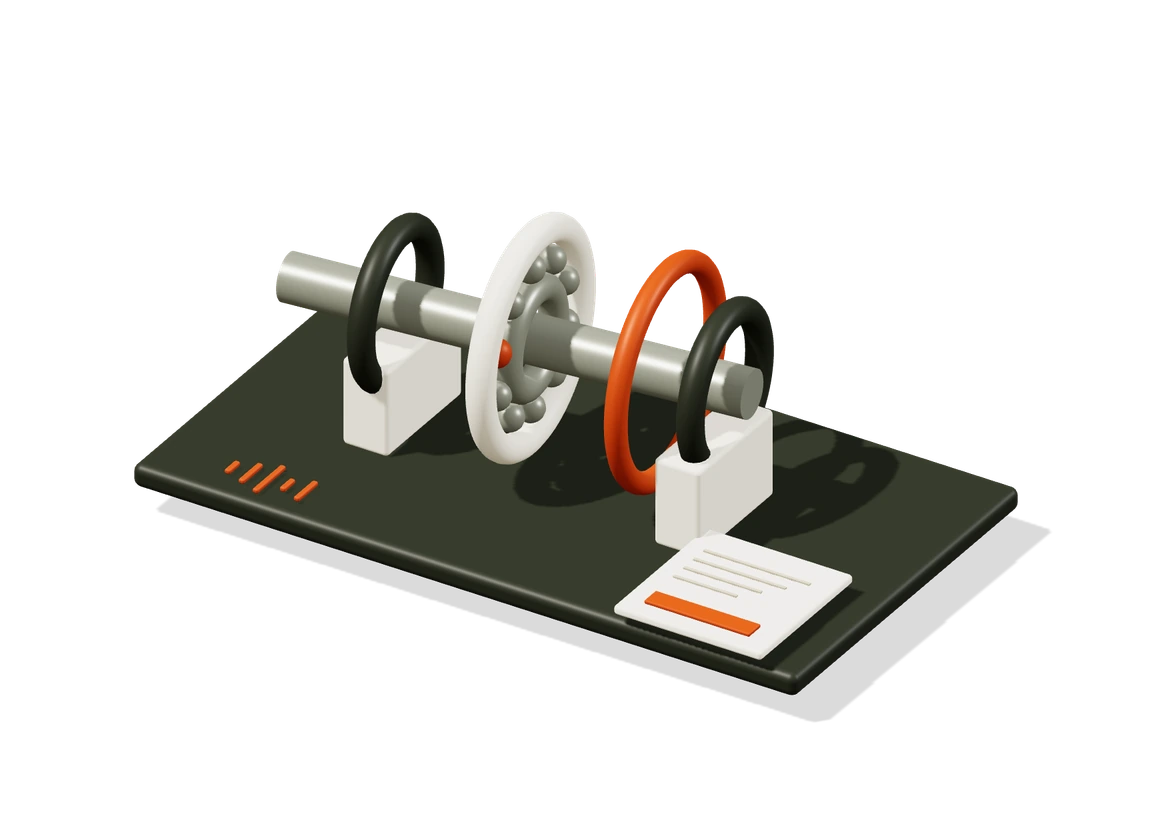
Detect a useful change
Condition models evaluate vibration, temperature or other available signals against relevant operating regimes.
 Start a project
 MaintainAI /Industrial operations
A condition alert needs an operational response. Connect detection models, asset knowledge and planning agents to prepare the evidence, parts and work scope your reliability team needs.
CONDITION · CRITICALITY · MAINTENANCE PLANNING01 /From condition to a working plan
Follow the path from an operating baseline to a planner-ready brief. This schematic illustrates the workflow; it is not live telemetry.
Compare like operating conditions before calling a change an anomaly. Load, speed and sensor quality matter.
02 /Models detect. Agents prepare.
Keep anomaly detection, technical assessment and work preparation connected, with distinct responsibilities.
Condition models evaluate vibration, temperature or other available signals against relevant operating regimes.
An investigation agent retrieves manuals, recent interventions and related alerts, preserving the evidence and uncertainty.
A planning agent gathers the work scope, parts and resource constraints for the maintenance team to approve.
03 /Ready for a real site
The evaluation has to reflect the assets, the available failure history and the way work gets scheduled.
Scope read access to historians, SCADA, edge gateways and the CMMS. Preserve asset identity, timestamps and operating state.
Assess useful warning horizon, false-alert burden and missed events by asset and failure mode. Document where a predictive claim cannot be supported.
Reliability planners approve work orders and operational actions. Existing machine safety controls remain authoritative. The workflow prepares maintenance work; it does not replace machine protection.
NEXT /A focused first engagement
Agree the workflow, the available data and the acceptance criteria. Build a bounded pilot, evaluate it with your team, then decide what to extend.
Shape your MaintainAI projectCUSTOM DEVELOPMENT · QUOTATION ON REQUEST01An asset and telemetry readiness assessment
02A condition-to-maintenance workflow
03A planner-reviewed pilot with alert-quality measures
Read the benchmark-based scenarioThe case file is a modeled engagement, not a client result.